Technical documentation
Understand Mnemos in five minutes, then inspect any layer in depth.
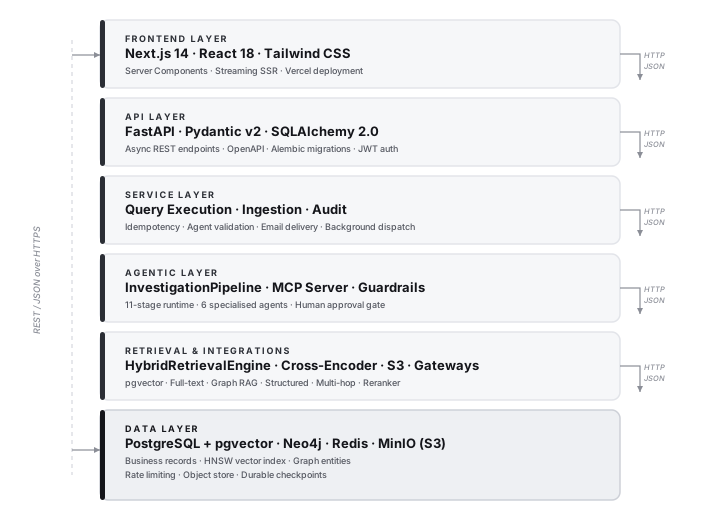
The documentation is structured for judges and technical evaluators: first the system model, then one end-to-end path, followed by focused engineering deep dives.
Thirty-second model
Mnemos connects evidence, reasoning, and governed action.
Evidence: industrial documents, asset history, work orders, inspections, procedures, and expert notes are converted into provenance-linked records.
Reasoning: a bounded agentic workflow classifies the question, selects a retrieval strategy, gathers vector and graph evidence, reranks candidates, and returns supported claims.
Action: the backend validates results and moves them into controlled workflows for RCA, compliance, expert knowledge, and audit.
Five-minute technical tour
01Start with the ownership boundaryThe frontend presents workflows, the backend owns application truth, and the agentic layer returns structured evidence rather than writing business records.Open →02Follow one document into the systemSee how a source becomes parsed content, evidence regions, chunks, embeddings, graph entities, and provenance-linked records.Open →03Follow one question through retrievalUnderstand query classification, entity resolution, retrieval planning, vector search, graph expansion, reranking, and evidence composition.Open →04See how operational knowledge is governedRCA, compliance, and expert knowledge move through reviewable lifecycles with role checks, approvals, and audit history.Open →05Review the production pathInspect infrastructure, health checks, migrations, secrets, rate limits, deployment, and service-level failure handling.Open →
What makes it technically distinctive
Depth is concentrated in the system, not dumped onto the operator.
Hybrid retrievalVector evidence, graph relationships, metadata constraints, and reranking are combined through a common evidence representation.
Evidence mappingEvery claim and graph assertion can resolve back to source document, revision, chunk, page or locator, extraction version, and review state.
Controlled ownershipThe agent returns a result; the backend validates, persists, audits, and exposes it. This avoids duplicate writes and state races.
Production-oriented controlsAuthentication, tenancy, rate limits, idempotency, retries, audit logs, health checks, migrations, and cloud deployment are already part of the design.